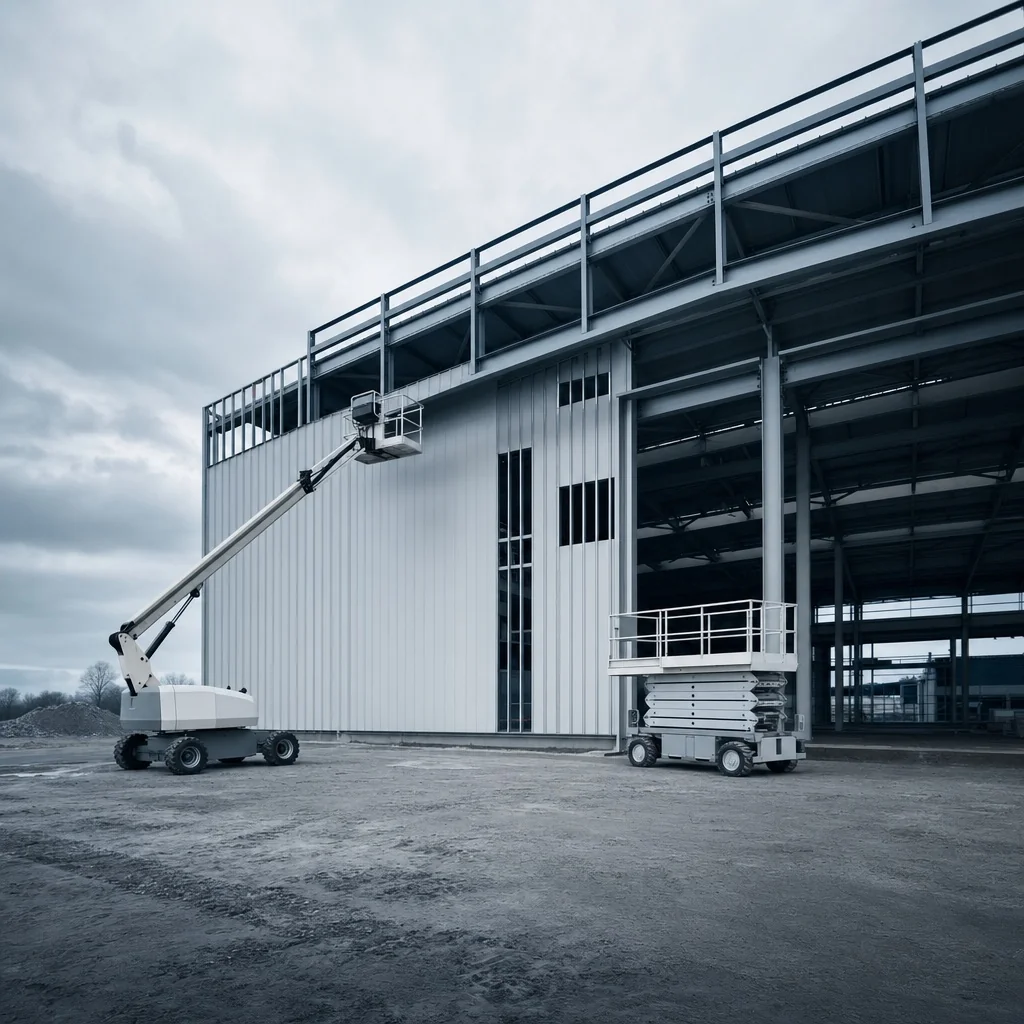
Plan the lift around the work face: ceiling height, aisle width, slab condition, and whether the machine can sit below the task or must bridge uneven ground.
Kansas City’s mix of high-bay logistics buildings and complex industrial sites sets the tone for scissor lift choices. Indoor floors favor compact electric units with non-marking tires, while outdoor work around utilities, panels, and façade trades may call for rough-terrain power and leveling. Seasonal temperature swings and moisture also influence battery performance and traction planning.
Start with the work geometry
Can the platform sit directly below the task, or does the work require outreach that points you toward a boom lift? If the task is straight up-and-down (racking, lighting, duct drops), scissor lifts are typically the comparison point.
Measure clear height and add space for tools and fixtures. Many local distribution buildings have tall bays, but interior obstructions like sprinklers and mezzanines can limit platform positioning.
Check aisle width and door heights common to warehouse corridors and loading areas. Compact slab units navigate tight turns better than wider outdoor models.
How Kansas City conditions affect the choice
Indoor work: Many facilities specify non-marking tires and low-emission equipment. Electric scissor lifts suit polished slabs and sensitive environments common to data and high-tech buildouts.
Outdoor work: Expansive clay soils and seasonal freeze–thaw cycles can leave ground soft or irregular. Rough-terrain scissors with higher ground clearance and stabilizing features are compared when the surface is unfinished.
Weather: Winter cold and humid summers impact electric lift battery runtime and hydraulic responsiveness. Plan duty cycles and charging access with temperature swings in mind.
Narrowing by platform height and footprint
Electric slab lifts: Common for inventory rack work, lighting, and controls inside large buildings. Look for compact footprints, tight turning circles, and non-marking tires. See /electric-scissor-lift-rental/.
Rough-terrain scissors: Consider for exterior cladding, steel, and utility runs where the slab is not yet placed or is interrupted. Wider stance and traction features suit jobsite approaches. See /rough-terrain-scissor-lift-rental/.
If the task cannot be reached from directly below, compare /aerial-lift-rental/ for articulating or telescopic booms.
Related aerial equipment in the city context
Articulating booms help navigate around overhead cable trays and duct mains typical in complex industrial interiors; see /boom-lift-rental/.
Vertical mast lifts can fit narrow aisles for light maintenance; see /vertical-mast-lift-rental/.
Equipment questions
Questions about Kansas City planning
What scissor lift style fits most Kansas City warehouse maintenance?
Electric slab units with non-marking tires are commonly compared for racking, lighting, and controls on polished floors, given the indoor air and floor protection requirements typical of local distribution buildings.
How do local temperatures affect electric scissor lift planning?
Cold conditions and humid summers can reduce effective battery runtime and alter hydraulic response. Planning around charging access and expected duty cycle helps account for the regional climate.
When should a boom lift be considered instead of a scissor lift here?
If the work cannot be approached from directly below—like reaching over conveyors, mechanical lines, or façade projections—articulating or telescopic booms from /aerial-lift-rental/ often become the comparison point.